Difference Between Upside Down Cards and Right Side Up Cards in Tarot Reading
cocky
A Beginner's Guide to Tarot Cards
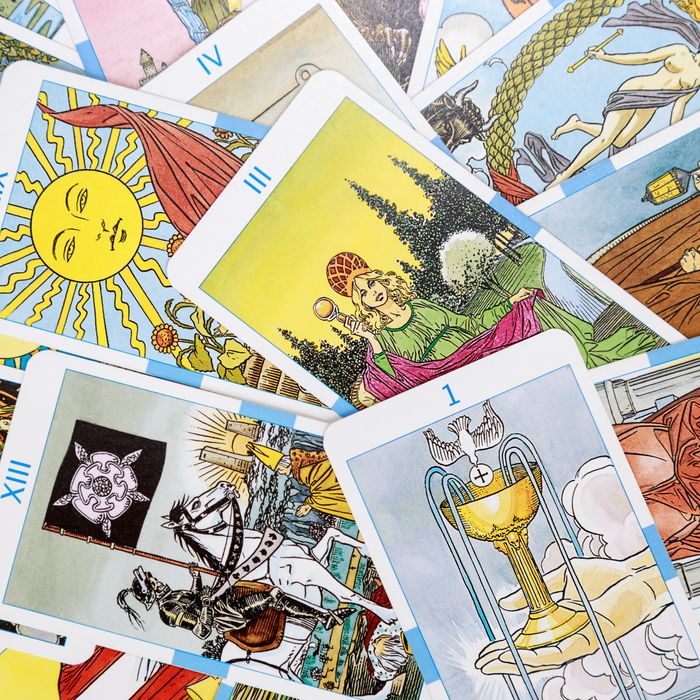
Photo: Getty Images/EyeEm
The last few years take seen a resurging interest in all things witchy, tarot cards among them. For some, tarot is a handy party flim-flam, a way to help a friend make connections they might take otherwise resisted. For others, the tarot is sacred, a powerful tool with which to direct 1's life.
Though tarot cards take taken on a mystical meaning in the cultural imagination, they were originally intended equally more than of a parlor game. The cards take been used since at least the mid-15th century; the earliest recorded decks originated in various parts of Italia. Not until the 18th century was the tarot used for the divinatory (or occult) purpose we know information technology best for today — Antoine Court and Jean-Baptiste Alliette are credited with popularizing tarot "readings" in Paris in the 1780s.
Between those who think it's a joke and those who retrieve tarot cards are actual magic lies a vast group who find them insightful and fun, if not necessarily supernatural. Whether information technology becomes a hobby or a full-time job, tarot reading (for oneself and for others) tin can exist an illuminating fashion to pass the time.
What practise I need to read tarot cards?
Commencement you'll demand a tarot deck. The most pop and well-known deck is the Rider-Waite, fatigued by illustrator Pamela Colman Smith and published in 1910. These cards are known for their elementary imagery, their uncomplicated color scheme (featuring lots of yellow, sky bluish, and grayness), and their symbolism. Many people recommend the Passenger-Waite deck for beginners, as the cards' meanings are and then frequently intuitive — and when they're not, plenty of interpretation guides exist in books and online. Many decks, including the Passenger-Waite, come with a little sheet of newspaper defining each of the carte's near common interpretations.
Though it's the best-known deck, the Rider-Waite is far from a first reader's only choice. The Wild Unknown deck is specially pretty, though — fair warning — a bit less intuitive for newcomers. The Morgan Greer deck is a bit similar the Rider-Waite on steroids: The symbols are similar, only the faces are bigger and bolder and the colors more brilliant and varied. In that location are modernized, diverse decks and Game of Thrones-themed decks. What's nearly of import is picking a deck with imagery that interests yous, with symbolism you can interpret. You're the i who'll be using them, so they have to fit your personality and style.
Photograph: Corbis via Getty Images
What do the different types of tarot cards hateful?
Though design varies greatly, all tarot decks are uniform in a couple of ways. Each includes 78 cards divided into ii groups: the major and minor arcana. The major arcana are the deck's 22 trump cards and, when pulled during a reading, typically refer to more major influences and revelations. These cards don't have suits and instead stand lonely, representing significant life events and/or figures in a person's life.
The minor arcana, by contrast, refer to more everyday matters and influences. These 56 cards are divided into iv suits: wands, swords, pentacles, and cups. (Occasionally, tarot decks will employ other terms, like "coins," for pentacles, but these are directly substitutions for the four original categories.) Each arrange represents a different facet of life. Typically, wands symbolize creativity and passion, swords symbolize intellect, pentacles symbolize work and money, and cups symbolize emotion. At that place are other groupings here, too; each adapt is too aligned with a grouping of astrological signs, such that wands = fire, swords = air, pentacles = Earth, and cups = h2o.
These meanings can come into play where cards stand for people and their zodiac signs, just since we're beginners hither, the meanings you lot'll most oft draw from are the functional definitions. For instance, a three-card spread that includes three pentacle cards strongly suggests an issue having to do with money. (More on the types of spreads in a moment.)
How do I prepare the deck?
Much of this is up to the deck's possessor and what feels right to them, only there are a few practices common to most tarot readings. If you're reading cards for some other person, you lot'll want to ask them to give you a question or prompt what they're curious near, and hold that question in mind while you shuffle the deck — also known equally "clearing" the deck from prior inquiries and readings. (Examples might include: "When will I observe dear?" "Am I on the right career path?" "How do I end my writer'south block?")
You might so ask the person y'all're reading for (also chosen "the querent") to cut the deck, once again focusing on their question. We similar this variation because it allows the querent to feel connected with the deck themselves, simply some readers will cut the deck for the querent. Either way, you'll then pull as many cards as yous demand for your spread, arranging them betwixt you and the querent — or only in forepart of you lot, if yous're reading for yourself.
Photo: picture brotherhood via Getty Epitome
How do I read the cards?
If you lot plant yourself asking what a "iii-card spread" is, this is the section for you. There are lots of ways to read tarot cards, and often the directions that come with your cards will include pictures of the most popular spreads. These include the simple three-card spread, the Celtic cantankerous, and a seven-day spread, merely you'll shortly learn that in that location's a spread for any state of affairs, and you can e'er make upwards your own, as well.
A 3-carte spread has the reader pull three cards from the deck later on it's been shuffled and halved by the querent (more on that in a moment). Usually, the showtime called pulled represents the past, the second represents the nowadays, and the third represents the future. How those timelines are interpreted depends on the reading and the question being asked — "future" might mean tomorrow or it might mean 10 years from now.
Another common use for tarot cards is a daily card reading, wherein a single carte du jour is pulled from the meridian of the shuffled deck and used as a reminder or a guideline for the day ahead. This tin can exist a very helpful practice for anyone looking to familiarize themselves with the tarot deck and the cards' meanings.
Simply what does it mean?
Information technology'southward important to consider each card'due south individual meaning, merely information technology'southward essential to consider the vibe and symbolism in the spread as a whole, too. Especially in larger spreads, in that location's as much data to exist gleaned from the overall film as its pieces. If you're reading for someone else, this is an opportunity to work with them — the more than pressure level yous feel to mind-read, the more challenging this will be. Reading tarot doesn't brand you psychic, which should come equally a relief: It'southward okay to inquire the subject questions about the cards and to brainstorm together ways in which the cards might use to their original question. Sometimes the cards won't friction match upwardly at all — the querent asks almost money, simply you pull two cups cards and "the lovers." This might suggest what they actually wanted to ask yous about was their love life. (Who doesn't?)
There are lots of ways to read tarot, but all of them require exercise. Learning 78 distinct cards takes fourth dimension, specially when so many of them take multiple possible meanings. Merely the more you read and touch on the cards, the more familiar they'll get and the easier information technology volition be to utilise them as a tool to amend sympathise yourself and others.
How do I learn more than?
If yous're looking to advance to the side by side level of tarot, there are a number of books you can buy and classes (online and off) you lot can take to sharpen your interpretation skills. Jessica Dore, a popular tarot reader and author of Tarot for Change, periodically offers online courses. Little Red Tarot also offers an eight-calendar week course on a sliding scale. There are as well many free lessons bachelor on YouTube, like those by spiritual adviser Mystic Rainn and John Ballantrae, who has a very soothing accent.
Source: https://www.thecut.com/article/tarot-cards.html
0 Response to "Difference Between Upside Down Cards and Right Side Up Cards in Tarot Reading"
Post a Comment